
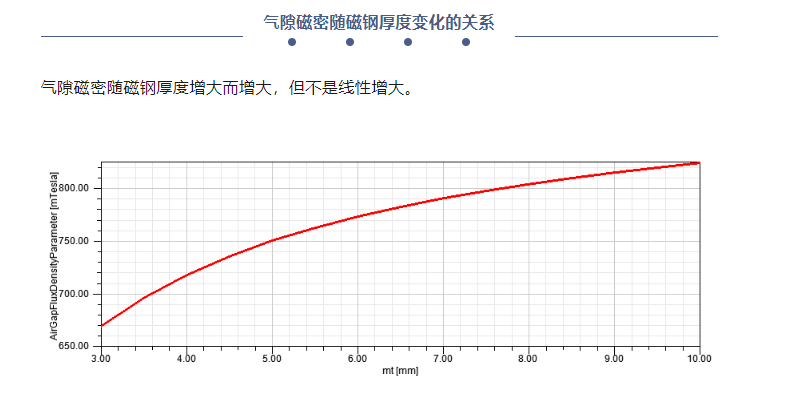
The magnetic circuit resembles an electrical circuit, with magnetic steel analogous to a power supply. Increasing thickness doesn’t alter residual magnetic flux but boosts internal magnetic resistance. When external magnetic circuit resistance stays constant, its magnetic flux rises.
Demagnetization: Higher magnetic potential raises internal resistance, reducing magnetic flux at the same demagnetizing potential, thus enhancing anti-demagnetization strength.
Weak magnetic performance is complex, akin to demagnetization analysis. High d-axis magnetic resistance (small Ld) complicates weak magnetism.
Back EMF upticks boost torque coefficient and reduce copper loss, but iron loss varies. Costs have soared.
Cogging torque intensifies when the derivative of magnetic energy vs. angle increases, given constant breath magnetic density waveform.
Reverse EMF waveform flattens due to tooth magnetic saturation’s third harmonic, augmenting torque fluctuations.
Magnetic steel, a crucial motor component, influences motor performance by affecting factors like magnetic flux density, flux, and reluctance, which in turn impact torque, efficiency, and output power.
Thickness’ impact on magnetic flux density: Thicker magnetic steel boosts flux density, enhancing torque under constant power and current.
Thickness’ impact on magnetic flux: Reduced thickness decreases flux, lowering motor efficiency.
Thickness’ impact on magnetic resistance: Lower resistance facilitates flux transmission, enhancing torque and efficiency. Designing for minimal resistance is critical.
In summary, varying magnetic steel thicknesses significantly alters motor performance, with substantial impacts.